
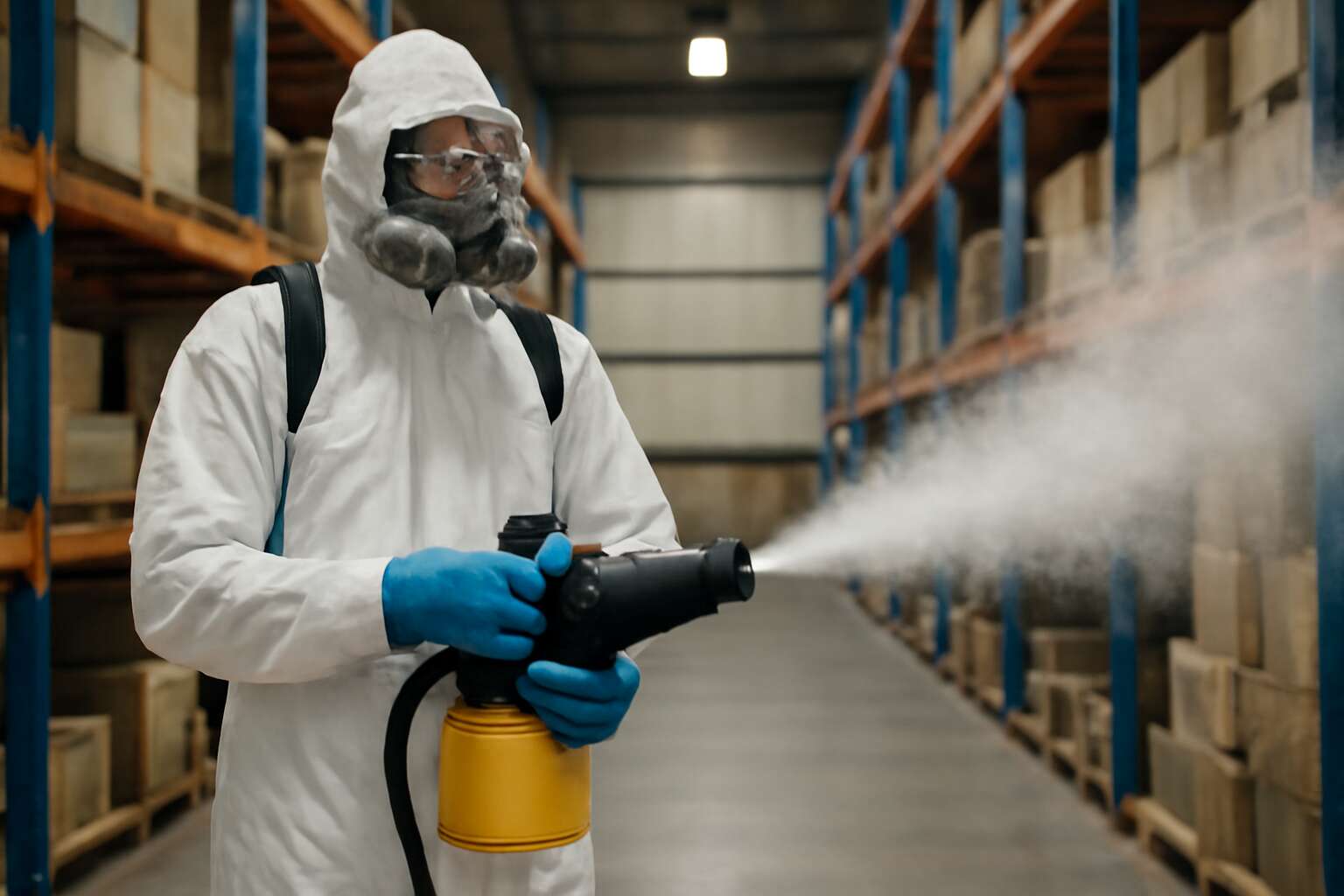
Overview of Chemical Fumigation
What is chemical fumigation and how it works
Pests can strip a pantry and fields of yield in days, and the right approach can mean the difference between harvest and loss. In South Africa’s rural communities, careful fumigation safeguards homes, granaries, and the season’s work, preserving food for families and neighbours and giving farmers breathing room through the hottest months!
Fumigation using chemicals works by introducing a controlled atmosphere that penetrates cracks, voids, and packing to reach hidden pests. Here are the core elements:
- Fumigants released into a sealed space reach hidden pests
- Cracks, voids, and packing are treated through a controlled atmosphere
- Post-treatment ventilation and monitoring confirm safety
Operated by licensed professionals, this approach balances efficacy with care for people, pets, and property across the region.
Benefits and limitations of chemical fumigation
An effective, decisive whisper against pests, fumigation using chemicals delivers a controlled breath through sealed spaces, reaching the quiet invaders hidden in cracks and packing. In South Africa’s storages and homes, the method promises speed without sacrificing safety, pairing potent action with careful venting and monitoring to protect families, farms, and the season’s yield.
- Deep reach into cracks, voids, and packing for hidden pests
- Controlled atmosphere minimizes post-treatment exposure through ventilation and monitoring
- Adaptable to granaries, homes, and rural settings across the region
Yet this approach carries limitations: it relies on licensed professionals, can incur higher upfront costs, and requires a window of downtime while spaces are aerated and checked for safety.
Key terms and concepts in fumigation
In a landscape where stored grain holds livelihoods, precision is king. Fumigation using chemicals delivers a decisive, quiet intervention that respects families and farms across South Africa, a controlled breath that reaches hidden invaders in cracks and voids. Understanding the terms that govern this process sharpens judgment and safety.
Key terms and concepts form the backbone of professional practice:
- Active ingredient and formulation
- Target pest and life stage
- Concentration and exposure time
- Aeration, ventilation, and monitoring
- Residue risk and safety standards
These terms create a concise lexicon for strategists and field teams, guiding safe, effective action in granaries, homes, and rural settings.
Environmental and health considerations in chemical fumigation
In South Africa’s quiet granaries, a single breath of protection can save livelihoods—fumigation using chemicals shields harvests from unseen invaders. Pests gnaw through months of labour, but this controlled intervention steers risk with mercy, delivering quiet, decisive action that respects families and farms.
Environmental and health considerations demand precision: residues, drift, and effects on non-target species must be weighed alongside effectiveness. The practice of fumigation using chemicals is a regulated art, requiring alignment with safety standards, proper containment, and thorough monitoring to protect farmworkers, communities, and water sources.
- Residue safety and regulatory compliance
- Worker health and community protection
- Ventilation and environmental stewardship
This measured approach—scientific, humane, and locally aware—reframes pest control as stewardship rather than intrusion, turning fumigation into a careful breath before the next harvest.
Common Chemicals and Formulations Used in Fumigation
Overview of fumigants (gases, liquids, and solid formulations)
Common fumigants come in three broad formulations: gases, liquids, and solids. This variety determines how quickly active ingredients migrate through crevices and voids, a consideration that matters for South Africa’s diverse structures—from chilly warehouses to sunlit storerooms. This balance is at the heart of fumigation using chemicals.
Under each form, a few representative approaches illustrate the range:
- Gaseous formulations (e.g., phosphine or sulfuryl fluoride-based systems)
- Liquid formulations (e.g., low-boiling solvents that carry active ingredients)
- Solid formulations (e.g., desiccant or extended-release pellets)
For professionals, choosing a formulation is a careful trade-off between speed, penetration, and safety; local regulations and health considerations shape every decision.
Popular agents: phosphine, sulfuryl fluoride, chloropicrin, and historical methyl bromide usage
In fumigation using chemicals, three actors dominate: gases that sweep through voids, liquids that ferry actives, and solids that linger. Popular agents include phosphine and sulfuryl fluoride as primary gas options, chloropicrin often included as a warning and penetrating co-formant, with methyl bromide occupying a historical, regulatory cautionary chapter.
- Phosphine — the stalwart gas for sealed-space fumigation
- Sulfuryl fluoride — rapid, with diffusion into complex layouts
- Chloropicrin — a warning agent and penetration enhancer
- Methyl bromide — historically dominant, now restricted and largely phased out
For the SA market, choosing among these requires balancing speed, diffusion, and safety within local regulations and health considerations. It’s a delicate dance we perform daily, aligning formulations with diverse structures—from chilly warehouses to sunlit storerooms—without inviting collateral risk.
Chemical properties and persistence of fumigants
Across South Africa’s sunlit storerooms, fumigation using chemicals remains both art and science. “We protect harvests with science and care,” says a veteran supervisor, reminding us that every seal, every gas pulse, and every check helps safeguard livelihoods.
Chemicals come in three broad forms, each with its own pace and footprint. Gases sweep voids; liquids ferry actives; solids linger. Their properties—volatility, diffusion capacity, and persistence—shape how quickly pests are stalled and how residues behave in ordinary goods.
- Gases: volatile and fast-diffusing; examples include phosphine and sulfuryl fluoride.
- Liquids: act as carriers that distribute active ingredients into porous materials.
- Solids: slow-release formulations that linger in corners to maintain residual activity.
From chilly warehouses to sunlit storerooms, understanding these formulations helps us safeguard livelihoods without compromising safety or the land we cherish.
Formulations, packaging, and handling considerations
In practice, fumigation using chemicals hinges on choosing the right formulation for the space and the inventory. In South Africa’s busy ports and inland warehouses, the choice of formulation matters. Gases arrive in pressure-rated cylinders with seals tested and calibrated meters to trace concentrations. Liquids act as carriers in drums or flexible packs, designed to wick into porous materials without over-saturation. Solids come as slow-release bricks or pellets, built to linger where pests hide.
Packaging and handling considerations focus on safety, traceability, and compliance.
- Packaging integrity: tamper-evident seals, proper caps, and corrosion resistance
- Labeling and documentation: batch numbers, SDS, expiry dates
- Storage and transport: segregated, ventilated areas away from heat sources
Technicians check seals and monitor concentrations before anyone re-enters treated spaces.
Regulatory status, usage guidelines, and labeling
From the dim glow of loading bays, fumigation using chemicals becomes a precise ritual, not a reckless gamble. A single mislabel can ripple through a warehouse like a cold wind. “The label is the law,” a veteran inspector reminds us, and the spaces themselves seem to listen to every instruction. Precision rules the quiet.
In South Africa, regulatory status requires registered fumigants, trained applicators, and documented permits for space treatments. Usage guidelines insist on following label directions, continuous monitoring, and controlled re-entry. Labeling must carry batch numbers, the safety data sheet, and expiry dates, with packaging integrity and transport compliance guarding the chain of custody.
- Common chemicals and formulations: phosphine gas, sulfuryl fluoride, chloropicrin; methyl bromide legacy
- Mandatory documentation: SDS, batch numbers, expiry dates
- Storage and transport: segregated, ventilated areas away from heat sources
Applications and Environments for Chemical Fumigation
Residential, commercial, and agricultural uses
Pests never take a holiday, and in South Africa their footprint on homes, farms, and warehouses is hard to ignore!
When the stakes are high, fumigation using chemicals offers a controlled, space-wide approach to displacing or killing infestations in enclosed spaces. It’s a method that prioritizes thorough reach where surface treatments fall short.
- Residential homes and apartment buildings
- Warehouses and retail facilities
- Agricultural storage such as grain silos
- Transit containers and export packaging
Applications span residential, commercial, and agricultural environments. In homes and apartment buildings, controlled fumigation using chemicals can safeguard stored food, fabrics, and structural integrity. In commercial settings, warehouses and processing facilities rely on it to protect inventory and compliance.
Across South Africa, choosing the right environment for this approach means weighing space, logistics, and safety considerations—without compromising efficacy.
Soil fumigation versus structural fumigation
South Africa’s grain belts meet pests with stubborn resilience. The choice between soil fumigation and structural fumigation determines reach, timing, and efficacy. Soil fumigation targets the root zone and under slabs, while structural fumigation sweeps enclosed spaces such as warehouses or silos. The key is selecting the right environment for fumigation using chemicals, balancing containment, ventilation, and regulatory compliance.
- Soil fumigation is applied prior to planting or storage, with gas distributed through the soil or under concrete to reach pests tucked away in the substrate.
- Structural fumigation seals spaces and relies on controlled atmospheres to displace or kill pests inside walls, floors, and contents.
In practice, site assessments weigh space, access, and safety. Structural fumigation demands airtight sealing and post-treatment ventilation, while soil fumigation hinges on soil properties and rainfall patterns. The environment decides the pace and reach of each application, as if an unseen presence guides the process.
Pest targets and effectiveness across environments
Across South Africa’s grain belts, fumigation using chemicals is a quiet duel with unseen pests. The environment—soil beds beneath slabs or sealed structures—sets the pace, containment, and the breadth of the attack!
Soil fumigation targets the root zone and under-slab refuges before planting or storage, weathering soil texture and rainfall patterns. Structural fumigation seals warehouses, silos, and containers, where a controlled atmosphere does the work inside walls and goods.
Targets shift with environment, guiding what a treatment can reach and when pests are most vulnerable.
- Soil fumigation targets nematodes and root-feeding pests hiding in the substrate.
- Structural fumigation targets stored-product pests such as moths and beetles inside walls, floors, and contents.
- Across environments, effectiveness hinges on timing, containment, and ventilation protocols.
Even with science in hand, this theatre remains a careful dance with safety and regulation. The right choice aligns pest biology with the environment, delivering a discreet, decisive finish.
Timing, scheduling, and site selection considerations
Across South Africa’s grain belts, timing can decide whether a storage cycle proceeds smoothly or a pest problem lingers. Applications of fumigation using chemicals hinge on the environment, pest biology, and the facility layout. Scheduling isn’t just a date on the calendar; it’s about aligning gas release, ventilation, and access for sealing with the way goods are stored and moved. When done right, a discreet, decisive treatment fits into operations with minimal disruption.
Key site selection considerations:
- Structure type and integrity, from sealed warehouses to containers.
- Pest biology and lifecycle stages to target during windows.
- Ventilation and containment to protect workers and adjacent areas.
- Access for setup, monitoring, and safe re-entry after treatment.
- Compliance with labeling, regulatory rules, and reporting requirements.
Site selection is as much a matter of logistics as pest biology; when the setting aligns, the effect is quiet but thorough.
Safety, Regulations, and Best Practices for Fumigation with Chemicals
Risk assessment, worker safety, and PPE basics
Safety in fumigation using chemicals is the quiet backbone of pest control—a drama where compliance and care write the score. A rigorous risk assessment maps exposure and emergency response, guiding decisions before a seal is broken.
Regulations in South Africa demand licensed operators, proper labeling, and containment to protect communities and ecosystems. Adherence respects people, pets, and property, and keeps work in line with compliant practice and insurance coverage.
- Respiratory protection appropriate to the fumigant
- Chemical-resistant gloves and footwear
- Coveralls or chemical-resistant suits
- Goggles or a face shield; splash protection
- Gas detectors and monitoring equipment for exposure awareness
Best practices weave risk control with respect for life and law—limit access, secure the site, maintain transparent records, and ensure informed training without turning to overbearing jargon. This is the glamour of disciplined science—the quiet tragedy and triumph of safe practice!
Regulatory frameworks, permits, and compliance requirements
Safety and compliance sit at the quiet heart of fumigation using chemicals, guarding people and property while the scene unfolds with clinical precision. In South Africa, regulatory frameworks require licensed operators, proper labeling, and containment to protect communities and ecosystems!
Regulatory touchpoints include permits, operator accreditation, and documentation that trace the containment and emergency response plans. The following elements help keep practice lawful and transparent:
- Permits and licensing
- Clear labeling and signage
- Site containment and waste handling
- Documentation, training records, and incident reporting
Best practices emphasize risk-aware decision making, secure access control, and ongoing training without jargon. Regulatory compliance isn’t a burden; it’s a framework that supports effective pest control and public trust in fumigation using chemicals.
Ventilation, containment, and monitoring during fumigation
In South Africa, the quiet art of fumigation using chemicals hinges on ventilation, containment, and vigilant monitoring. Pest pressures spike with seasonal rains, and safety is non-negotiable—regulated programs reduce exposure incidents by up to 40%. It is a careful balance between protecting people, pets, and property, and achieving pest control with minimal drift!
- Ventilation planning that minimizes exposure to non-target areas
- Containment strategies to prevent drift and leakage
- Real-time monitoring and documentation to verify safety and regulatory alignment
Beyond site specifics, South Africa’s regulatory framework anchors fumigation projects in licensing, labeling, and transparent record-keeping. Best practices emerge from risk-aware decision making, clear communication with stakeholders, and ongoing training—keeping communities confident in the science and stewardship behind this craft.
Decontamination, waste management, and environmental safeguards
Across South Africa, safety is the unseen backbone of fumigation using chemicals. Regulated programs have cut exposure incidents by up to 40%, turning peril into precision. Decontamination and waste management aren’t afterthoughts—they’re the spine of responsible practice, protecting people, pets, and property while preserving the environment. We treat every site like a careful ritual—calibrated, science-led, and respectful.
Regulatory frameworks anchor every fumigation project with licensing, clear labeling, and transparent record-keeping. Compliance isn’t a box to tick; it’s a trust-building ritual that keeps communities confident in the science and stewardship behind this craft.
Best practices grow from risk-aware decision making, open stakeholder dialogue, and continuous training. They surface in how we manage decontamination, waste, and environmental safeguards—every choice measured, every footprint minimized.
- Decontamination and waste management aligned with environmental safeguards
- Documented monitoring and regulatory alignment
- Transparent communication with stakeholders
- Ongoing training and competency verification
Training, emergency procedures, and record-keeping
In South Africa, safety in fumigation using chemicals is the quiet backbone of every operation—calm, precise, and relentlessly preemptive. Teams train to read breath, vapour, and doorways with the same focus a conductor uses for a symphony, turning risk into ready response and protecting people, pets, and property.
Training, emergency procedures, and meticulous record-keeping anchor every project. The practical elements include:
- Structured training modules and competency verification
- Clear emergency procedures with alarms, evacuation routes, and rescue plans
- Thorough documentation of permits, monitoring data, and post-closure records
Regulatory alignment isn’t a formality—it’s the trust that communities count on. Regular audits, transparent reporting, and continuous improvement keep fumigation using chemicals safe, compliant, and scientifically grounded across environments in SA.
0 Comments